Patrick Bateman's depersonalization
American PsychoPatrick Bateman's depersonalization is the defining psychological and narrative condition of his existence: he possesses the surfaces of a recognizable person while experiencing no secure inner identity behind them. His clothes, grooming, manners, professional language, possessions, and social rituals continually construct a public Patrick Bateman, yet the consciousness describing these details repeatedly reports emotional extinction, derealization, and the sense that the person being performed is only an abstraction. The result is not simply private numbness but a breakdown in the distinction between appearance and reality, in which violence, fantasy, social routine, and self-description become impossible to separate with confidence.
Public Performance and the Absent Self
Patrick Bateman's depersonalization is first registered through the precision of his social presentation. At Courtney's brownstone, he hands over his black wool Giorgio Armani overcoat, receives her carefully staged air kiss, and participates in the same ritual with Timothy Price while the new Talking Heads CD plays softly. The scene presents identity as choreography: clothing, gesture, music, and etiquette make the participants legible before any sincere feeling does. The performance is polished enough to seem ordinary, but its exact repetition also suggests that personality has been reduced to a set of reproducible movements.
The same logic governs his professional self-display. At dinner, Patrick Bateman takes out a gazelleskin wallet purchased at Barney's for $850 and places his new business card on the table, waiting for the others to react. The card is not merely an identification tool; it is an object through which status and individuality are supposed to become visible. Yet the response treats it as possibly a packet of cocaine, collapsing distinction between corporate prestige and consumption. The self therefore depends on surfaces that are both intensely valued and fundamentally interchangeable.
His surroundings reinforce this instability. Luis Carruthers appears at the bar in an unfashionable Chaps suit, striped shirt, silk bow tie, and horn-rimmed Oliver Peoples glasses; Patrick notices the discrepancy as part of a system in which people are judged through labels and visual codes before they are acknowledged as persons. Similarly, the counted inventory of silk-crepe, Versace, foulard, Kenzo, and jacquard ties, mingled with fragrances such as Xeryus, Tuscany, Armani, Obsession, Polo, Grey Flannel, and Antaeus, becomes a cold, sickening perfume rather than an expression of taste. Material detail does not furnish a self. It produces an atmosphere in which the self disappears beneath brands.
Emotional Erasure and Sensory Disintegration
Patrick explicitly describes his condition as a gradual destruction of ordinary human feeling. Everything has become dull to him, including sunrise, heroism, love, war, and the discoveries people make about one another. Greed and total disgust remain as possible emotions, but even these are not integrated into a coherent personality. He recognizes that he has flesh, blood, skin, and hair, yet says that the capacity for compassion has been eradicated through a slow, purposeful erasure. He is imitating reality, a rough resemblance of a human being, while only a dim corner of his mind continues to function.
The contrast between bodily presence and psychological absence is central. Patrick can identify the sound of ice dropping into a glass of J&B as calming, but he cannot identify a clear feeling within himself. The sensory object offers a brief, mechanical relief where emotional life should be. His relation to objects is therefore more stable than his relation to people: a drink, a garment, a phone, a business card, or a Walkman can be catalogued and manipulated, while compassion, guilt, and attachment remain inaccessible.
The condition becomes physically chaotic during his August breakdown. After telling Jean to say no and abruptly hanging up, Patrick experiences the Walkman around his neck as a boulder, throws it into a trash can, and moves through the city sweating, cramping, foaming at the mouth, and struggling to recover a sense of normality. He considers buying a teapot, then purchases butcher knives, an ax, hydrochloric acid, a Habitrail, and two white rats for torture, although the package is later abandoned while he shops. He shoplifts canned ham, vomits it against a poster for Les Misérables, repeatedly mutters that he must return his videotapes, buys two copies of The Return of Bruno, and becomes trapped in a revolving door. These actions do not form a coherent plan so much as a chain of displaced impulses, consumer gestures, bodily symptoms, and violent possibilities.
The episode shows depersonalization as a failure of continuity. Patrick shifts from office obligation to music, from appetite to nausea, from shopping to cruelty, and from public composure to delirium without arriving at a stable motive. Even his attempt to resume normal life is immediately interrupted by pain and compulsion. The city remains full of movement and sound, but passersby ignore him so completely that their indifference briefly sobers him. Social invisibility becomes both a symptom of his alienation and the condition that permits his public identity to continue.
Desire, Violence, and Relational Substitution
Patrick's relation to Courtney Lawrence and Luis Carruthers shows how depersonalization converts intimacy into competition, possession, and calculation. He wonders whether Courtney would like him more if Luis were dead and whether she would spend the time currently devoted to Luis with him if Luis were removed as an alternative. He considers whether killing Luis would make his own world safer and imagines strangling him in the men's room. The question is not presented as a settled emotional confession but as a grotesque extension of the same logic governing his clothes and possessions: a person becomes an obstacle that might be eliminated to improve access to another desirable object.
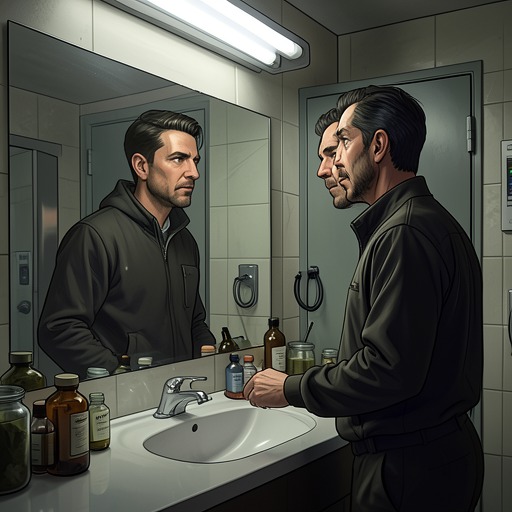
Before approaching Luis, Patrick checks his reflection, confirms that his tan, haircut, and teeth are perfect, and puts on leather Armani gloves. The mirror and the gloves are part of the preparation, linking violence to the maintenance of appearance. In the deserted men's room, Luis is found urinating in an unlocked stall; Patrick circles his neck and begins to squeeze. The scene exposes the backstage of the polished social world, but even there Patrick remains organized by costume, bodily inspection, and controlled gesture. The threat does not emerge outside the performance so much as reveal what the performance has been containing.
His treatment of the homeless man follows a related pattern of emotional refusal. When the man says that he is hungry and has lost his job, Patrick keeps a bill in his hand but out of reach and asks why he does not get a job. The man's hunger is concrete, but Patrick responds with an abstract demand that converts suffering into personal failure. Depersonalization thus operates socially as well as internally: other people are denied full personhood at the same moment that Patrick experiences himself as only a body and a role.
Identity Confusion and Unreliable Reality
The condition also destabilizes names, recognition, and evidence. Patrick's social world is marked by mistaken identities and weak recognition, while his own narration offers uncertain perceptions rather than secure testimony. A person he encounters may be Charles Murphy from Kidder Peabody or Bruce Barker from Morgan Stanley; someone else resembles Vincent Morrison or Tom Newman. Such uncertainty is not incidental decoration. It shows a world in which institutional affiliation and appearance are more available than individual identity.
The disappearance of Paul Owen intensifies this problem. Patrick's day is organized around meeting Paul Owen for dinner under the name Marcus Halberstam, after exercising at the Yale Club and making reservations at Texarkana. Later, Donald Kimball arrives at Patrick's office and explains that Meredith Powell hired him to investigate Paul Owen's disappearance. Patrick's controlled response to the investigator coexists with the reader's awareness that the name, the meeting, and the disappearance belong to a deeply unstable narrative field. The investigation offers a possible external framework for reality, but it does not resolve the gap between what Patrick says, what he imagines, and what may have occurred.
That gap reaches its most extreme form when Patrick, after a violent night, calls Harold Carnes from his new office and confesses to thirty, forty, or a hundred murders, leaving a message because Harold is away on business in London. He reports abandoning a woman near a Dunkin' Donuts and watches police cars, ambulances, flares, and a SWAT team gather around another building while dawn rises over Manhattan. Yet the scene is structured through his exhausted, sobbing consciousness, and the surrounding events do not provide a stable confirmation of his account. The confession therefore functions simultaneously as apparent admission, psychological discharge, and unreliable narration.
Philosophical Void and Futile Confession
Patrick's most sustained statement of depersonalization describes a reality emptied of moral and emotional value. He sees not nature, earth, life, and water but an unending desert or crater without reason, light, or spirit. He says that he never imagines people as good, that a person can change, or that the world might improve through pleasure, love, kindness, or generosity. Sex becomes mathematics, individuality becomes irrelevant, desire becomes meaningless, and intellect fails to cure anything. Fear, innocence, sympathy, guilt, grief, and failure are treated as emotions no one genuinely feels; evil alone appears permanent.
This vision converts personal emptiness into a theory of civilization. Patrick does not merely lack compassion; he interprets the entire social order as surface, performance, and calculation. His surroundings support the interpretation: fashionable clothing and restaurant rituals coexist with hunger, abandoned buildings, violence, and reports of bodies recovered from the East River. The office brings further signs of a reality that cannot be organized into moral coherence, including bodies found frozen, hacked up, and bloated, an epidemic of poisoned Evian bottles, and a public mood described through zombies, randomness, and vast chasms of misunderstanding.
The final formulation is even more radical. Patrick says that there is an idea of Patrick Bateman, an abstraction, but no real self—only an illusory entity whose personality is fabricated, sketchy, and unformed. His conscience, pity, and hopes have either disappeared or perhaps never existed. He claims to have surpassed every barrier separating him from the uncontrollable, insane, vicious, and evil, while also insisting that no one is safe, nothing is redeemed, and he is blameless. The contradiction is crucial: he acknowledges responsibility for mayhem and indifference while denying the stable moral self that could bear responsibility.
For that reason, confession produces no catharsis. Patrick says that he has admitted the truth countless times through his acts and that no deeper knowledge can be extracted from telling it. The confession has no reason and means nothing. Depersonalization is therefore not cured by self-recognition; language itself becomes another performance that fails to create an accountable subject. His most revealing declaration is also his most empty one: the narration exposes the structure of his absence without restoring the person who might stand behind it.